Low health literacy has been closely associated with medication non-adherence and errors which lead directly to increased hospitalizations and higher medical costs. This has direct impact on the success of the “triple aim” – reducing healthcare costs, improving patient satisfaction, and health outcomes. Providers need to identify patients with limited health literacy and tailor medication counseling to their needs.
Medication Self-Management Challenges
There are multiple reasons people struggle with medication adherence.- It is difficult to establish a routine if taking medication involves tapered and escalating doses. Adding, adjusting, and removing medicines makes it very hard.
- There is a confusing array of drugs and devices (pills, injections, inhalers, liquids, nasal drops, eye drops)
- The names of medications are hard to remember. Brand names vs. generic names. Pills look different)
- Doses are often dependent on measurement (weight, blood sugar). People struggle numeracy skills.
- Patients interact with multiple prescribers and pharmacies, get varied and sometimes poor instructions.
In the understand and organize steps alone, people might not know:
- How many pills per dose?
- How long between doses?
- How many pills per day?
- How many milliliters in a teaspoon?
- Is twice a day the same as every 12 hours?
- Can I take these medicines at the same time?
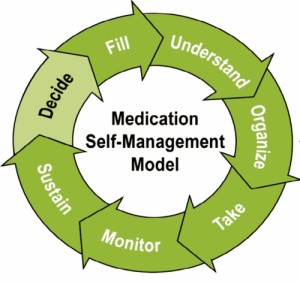
When people feel overwhelmed they disengage. It is dangerous for any patient or primary caregiver to be passive about medication adherence. Help patients stay engaged.
- Explain medication instructions in simple terms.
- Break instructions into steps and clarify at each step using teach back.
- Help patients form good habits like bringing medication bottles to appointments. Praise such active involvement.
- Make sure they understand the purpose of prescribed medications
Medication Assistance in Pharmacies
People often don’t ask pharmacists questions about their medications. This is especially true in pharmacies located in retail outlets – i.e. discount stores and supermarkets. Store customers paying for groceries and other non-pharmacy items create longer lines of impatient customers. It is awkward to have a conversation with a busy pharmacist when so many people are waiting to pay. Typically, pharmacy customers receive their prescriptions in paper bags stapled shut. Later, when there is no one to answer questions, they may struggle to make sense of prescription instructions. Resource: The medication self-management model presented in this article borrowed from Dr. Michael Wolf’s Health Literacy & Numeracy Workshop. (Presentation on youtube.com)Improving Medication Adherence for Low Health Literacy Patients
Written by Marcia Carteret, M. Ed. © 2013. All rights reserved.