Referrals to mental health services ourside a practice setting by medical providers are often problematic in cross-cultural encounters. Mental health services in the United States are based on cultural assumptions relevant to members of the mainstream society, but these assumptions may not be as relevant for people outside the dominant culture. Thus, clients from different cultural backgrounds may not understand what the specialist referral is about or why they need to go. Perhaps in no other encounter is the provider’s choice of words more important. Due to the intense stigma against the very idea of “mental health” in many cultures, doctors must find ways to phrase their referrals that avoid directly talking about mental health. Much of what is suggested in this article will improve conversations about mental health referrals for patients and families from ALL cultures.
The Importance of a Family-Centered Approach
Many cultures that stigmatize mental illness are also cultures with a value system rooted in collectivism. Modern talk therapy, however, is a extension of individualism which presents the individual as an independent entity whose needs, rights, opinions, and values must be respected first. In “therapy” as it is usually conceived of in the U.S., self-actualization is almost always an important therapeutic goal. Most mental health providers in the U.S. would agree that it is natural and healthy in human development to undergo an important psychological separation from one’s parents. This is viewed as essential to the development of a unique and autonomous identity. (Erikson, 1963; Mahler, 1968). The process of personal development does not occur in the same way in collectivist cultures in Africa, Asia, South America, or Arab countries. (Sue & Sue, 1990). In collectivist societies, the group or family identity remains the focus and the individual remains embedded in the collective identity. Thus, all interventions with families from collectivist cultures need to be couched in the context of the family and extended family. This is most true for less-acculturated immigrants and refugees.Build Relationship
Though often running short on time, providers will find that if they spent a little more time up front establishing rapport with families, it will save time in the long run and increase compliance as well. In pediatric cross-cultural encounters, a great start to any conversation is: “Families are so important to children, and I like learning about families in my care. Would you tell me a little about yours?” If this doesn’t jump start dialogue, the provider can include more specific questions. With an immigrant or refuge, family questions might include:- Where does your family come from originally?
- How long have you been in ______ (town or Colorado, etc.)
- Is your whole family united here together, or do you have family members who are still far away? (This is an emotional subject but important to understanding the family dynamics and circumstances. Are both parents in the home?)
- Who helps mom most with child care?
- Does Grandma live with you and the children?
Examples of Cross-Cultural Barriers to Mental Health
- Depression and stress are symptoms not recognized in many traditional cultures.
- Many people from non-Western cultures may think that frequent crying, insomnia, chronic headaches, etc. are just a part of life. These may not be considered things that warrant treatment.
- In many collectivist cultures, any emotional problems are related to the “family” not the “individual.” There is something unsettled in the family interpersonal relationships. Patients may actually steer away from personal “preoccupations” that detract from focus on the good of the family.
- Self-disclosure may suggest betrayal of one’s own family, weakness or failure and associated shame.
TRY TO Identify the Belief System OF the Family
Human beings define intimacy, relationships, motivations, assertiveness, and will-power within a particular cultural context. To assume that these are conceived of universally by all human beings is extremely ethnocentric. Similarly, ideas about health, both physical and mental, are also culturally-derived.- Be aware of alternative belief models – in fact anticipate that they may exist.
- Learn about some common culture bound illnesses – susto, evil eye, Zar, etc.
- Ask families what resources are available to them in their community – (i.e. a healer, a clan leader, or pastor, etc.)
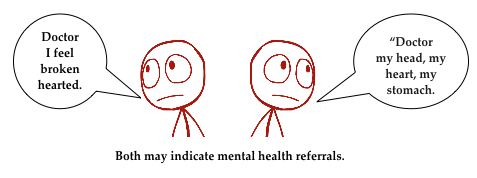
Listen for Common Idioms of Distress
- Sinking of the heart
- Burning of spleen/liver/scalp
- Trouble sleeping, nightmares
- Decreased appetite
- Fatigue
Keys to Making the Referral
- Frame the referral together.
- Ask how the problem might be addressed in their country of origin. Has anyone in their family experienced this problem? How was it dealt with?
- Frame the referral in their terms as a solution to the change they have indicated hoping to see. (“We have doctors like me who help families with a child who is waking at night from bad dreams.”)
- Express encouragement – it is GREAT they are seeking help for this challenge their family is facing.
- Explain what they can expect as the next steps. (i.e., they will be given a phone number, they will meet with a care coordinator, they will make an appointment, they will go to such and such a place for the appointment, first someone will ask them “intake” questions…)
When NOT to Make the Referral
Sometimes making the referral is not the best move. Unless there is a psychiatric emergency, if the family seems very resistant to talking about the problem at hand, the best next step may be to try to get them to come back soon for a follow up visit – ideally within two weeks. Of course this depends on the urgency of the problem.- Ask them to schedule a follow up visit, and suggest one corrective measure for them to work on in the meantime.
- During the second visit, elicit more of their story and their concerns. Build relationship! It is the key leverage needed for a successful mental health referral. If they don’t trust you, they won’t follow through on your referral.
- Try to get key decision makers who are absent from the first appointment to come to the second appointment – especially grandma.
- Erikson, E. (1963). Childhood and Society. New York: W. W Norton
- Mahler, M. (1968). On human symbiosis and the vicissitudes of individuation: Infantile psychosis (Vol. 1) New York: International University Press.
- Sue, S., & Sue, D. (1990). Counseling the culturally different: Theory and practice (2nd ed.) New York: Wiley and Sons.
Effective Mental Health Referalls
Written by Marcia Carteret, M. Ed © Copyright 2015. All rights reserved.